Saturday, October 22, 2016

Back to our roots

As days get darker, shorter and chillier, as the vegetables of summer disappear from the market, it's time to get back to our roots, all those colorful vegetables that have slowly been soaking up the energy and minerals we're going to need now. They are many. They are tubers, bulbs, rhizomes and corms. They are vivid. They are nourishing. They store well, think "root cellars." They are also mighty tasty.

To name just a few, believe it or not, they are: beets golden and magenta. burdock, carrots in all their colors, celeriac, daikon, fennel (it's not called fennel bulb for nothing), Jerusalem artichokes aka sunchokes, kohlrabi, leek, onions red and white and yellow, parsnips, potatoes of all colors and sizes, radishes, rutabaga, salsify, shallots, sweet potatoes, turnips and yams plus garlic, ginger, turmeric, and coriander.

What to do with all this bounty?  Here are a few hot and cold ideas perfect for right now.  With apologies for the terribly Google blogger formatting I can't control.

Borscht

 There are many recipes for this famous Slavic red beet soup: with or without meat, hot or cold, pureed or chunky.  I like this bonanza right now when it's not quite cold enough for a very hearty, slow simmering meat borscht because it celebrates the roots of autumn in the tastiest, most colorful and low calorie way. It also lets you use the beet greens so their vitamins don't go to waste. Perfect for vegetarians--and if you forget the sour cream topping, vegans too. Plus it's a cinch to put together.

Serves 4-6


3 large or 8 small fresh red beets, peeled

1 bunch of small beet greens, washed and dry

1 large onion, peeled

2 large carrots, peeled
2 turnips, peeled

¼ lg. white cabbage with outer leaves discarded, shredded as if for coleslaw

3 medium sized red or new potatoes, peeled and cut into bite-sized pieces

5 cups vegetable stock

Juice of one lemon

1 tbsp balsamic vinegar

2 tsps. dill seeds

1/8 tsp. Szechuan pepper or Nepali timur, or for a slightly different taste crushed juniper berries

1 tsp. celery seed

1/8 tsp. ground allspice

1/4 tsp. cracked pepper

1 tbsp butter

¼ cup olive oil

1/4 tsp. salt

½ cup fresh dill, chopped

Sour cream or thick yogurt and 1/8 tsp. caraway seed to garnish


Either finely chop the onion or chop it in a food processor into tiny pieces.

Grate, shred or finely chop in a food processor the carrots. Then do the same to the beets and beet greens and turnips. Do not puree but chop into small bits to get a thick soup. Ground the dill seeds in a coffee grinder, small chopper or mortar and pestle. 

Over medium high flame, heat the olive oil in a heavy gauge soup pot or large casserole. When it is hot, add the Szechuan pepper, ground dill seed, celery seed, allspice and stir to blend.  Add the onion and stir fry for one minute.  Add the butter and once it melts, add the carrots and stir fry for two more minutes. Add the cracked black pepper, beets and beet greens. Stir to blend, lower heat to the lower end of the medium range and cook about five minutes, until vegetables are soft. Stir frequently to prevent burning.
 Add half the lemon juice and 1/8 teaspoon of salt and stir to blend.
Add the vegetable broth, shredded cabbage and diced potatoes. Bring to a boil, then lower heat to simmer. Cover the pot and simmer for 20 minutes.

 Stir in the remaining lemon juice. Taste for salt and add to your taste.
Remove from heat.  Toss in the fresh chopped dill.  Ladle into soup bowls and serve with a dollop of sour cream or yogurt in the middle of the bowl. Sprinkle caraway seeds over all and enjoy.


Crunchy slaw (celeriac, daikon, carrots, fennel bulb, sunchokes and salad turnips)
There is truly no exacting recipe for this. Just do what you can and it will be fine.
serves 4 -6

1 med celeriac, peeled and cleaned
3 med/lg carrots, peeled
1 sm daikon, peeled
1 fennel bulb
2 chiogga or golden beets, peeled and cleaned
4 sunchokes, peeled
4 med/lg salad aka Hakurei/Tokyo turnips, cleaned
1 med purple onion, peeled 
Sea salt and freshly ground pepper to your taste

Grate the celeriac, carrots, daikon, salad turnips, beets and sunchokes into a large bowl.
Core the fennel bulb and slice in crosswise into very thin strips. Add to the bowl.
Half the onion and cut it into very thin strips. Add to the bowl and blend everything.
You should have a rainbow in there. Add salt and pepper. Blend.

For the dressing:

3 garlic cloves, minced or mashed
1 tsp. dried tarragon
½ tsp. Dijon-type mustard
½ tsp. caraway seeds
1/2 c vinegars: I mix Balsamic, Japanese rice wine and plain red wine (you can also use apple cider vinegar for a slightly sweeter taste)
¼ cup olive or corn oil
salt to taste
Combine everything and whisk to blend. Pour as much as you want over the slaw and serve.
Rutabaga and Potato Gratin with onion, leeks and garlic

This recipe is from Veggiyana, the Dharma of Cooking, and was a huge hit in Mongolia!
Serves 6-8

1 tbsp olive oil (you can use butter if you prefer)
1 small onion, diced
2 garlic cloves, peeled and minced
2 cups heavy cream (you can substitute one cup of evaporated milk for one cup of cream but the final dish will be soupy)
½ tsp salt
½ tsp coarsely ground black pepper
¼ tsp ground nutmeg
¼ tsp dried rosemary leaves
1 star anise, crushed (if you don’t have star anise, substitute ½ tsp dried tarragon or 1/8 tsp ground cloves)
1 ¼ lb baking potatoes, peeled and sliced into thin disks
1 large rutabaga (1lb), peeled and sliced into thin disks
1 large leek, sliced into thin disks and washed
½ lb. Gruyere cheese, grated

Preheat oven to 375º and get out a baking pan approximately 11” x 7”. 

Heat the olive oil in a small sauté pan.  Add the garlic and onion and sauté over medium heat for about 3 minutes, until the onion starts to soften.  Remove from heat and add the salt, pepper and nutmeg.  Stir in the cream.  Spread the leeks evenly around the bottom of the baking dish. Don’t worry if there are gaps, just be sure they are uniform.  Cover the leeks with a layer of potatoes (half the potatoes). Sprinkle the rosemary over the potatoes, then sprinkle ½ cup of cheese.Add a layer of rutabaga, using half of what you have. Sprinkle the crushed star anise around this layer and then ½ cup cheese too. Repeat a layer of potatoes and cheese, then a layer of rutabaga. Pour the creamy onion mixture over everything as evenly as you can and bake for 30 minutes in convection or 35 minutes in a regular oven.  Sprinkle the remaining cheese over the top and continue to bake another 12-15 minutes, or until the rutabaga is tender and the cream seems to be solid. (It won’t be if you used evaporated milk.) Remove from the oven and let it cool at least 5 minutes before serving.  You can sparingly add freshly chopped flat leaf parsley for color if you wish.

Tibetan lamb with daikon, ginger, onions and garlic

serves 4

1½ -3/4 lbs. stewing lamb pieces with bones
1 lg. daikon, peeled
2 med./lg. onions
3” fresh ginger, peeled
7 lg. garlic cloves, peeled
¼ tsp. Szechuan pepper or ¼ tsp. coarse ground black pepper & 1 dried chili
½ tsp. salt
4-6 cups water
1 lg. tomato, cored
¼ tsp. mild chili or 1/8 tsp. cayenne powder
1 tbsp. corn, safflower, canola, mustard oil
6-8 med. Asian mustard greens (1/2 a bunch)*
 *You can substitute dandelion greens or large arugula. You want pungent.
  
Cut the daikon into two inch long pieces (probably 5 to 6). Quarter one onion.  Smash the ginger and 6 garlic cloves with the back of a knife.

Put the lamb, daikon, quartered onion, ginger, garlic, pepper and ¼ tsp. salt in a medium casserole or lidded saucepan and barely cover with water. Depending on the width of the pot, this will require four to 6 cups.  Bring to a boil, cover, lower heat and simmer for an hour or a few minutes longer, until the lamb is just tender enough to fall easily from its bones. Remove the lamb and daikon from the broth. Boil the broth hard for 15 minutes to reduce it. (This is the point at which you can cool everything and put it in the refrigerator until you want to serve it.)

Take the lamb meat off the bones, discard the bones and cut the meat into bite-sized pieces. Cut the daikon lengths into thin (1/8”) discs, then cut them in half lengthwise so you have semicircles.
Chop the remaining onion finely. Chop the tomato finely. Mince the remaining garlic clove. Degrease the broth and strain it.  Over high heat, heat the tbsp of oil in a wok or large sauté pan that has a lid.  Add the onion and garlic. Stir fry to brown.  Add the chili or cayenne pepper and blend.  Add the lamb. Stir to blend. Keep cooking on high about 90 seconds to brown the lamb slightly. Add the chopped tomato, another ¼ tsp. salt and ½ cup of the broth. (If you’d like this really “stewy” and not braised, add ¾-1 cup of broth.) Cook about five minutes until the tomato dissolves into the juice and the broth is boiling.

Coarsely chop or break the mustard greens in half or thirds (depending on their size), lay on top of the lamb and daikon, cover the pot and steam for two minutes. Remove the lid, stir the greens into the “stew”, adjust for salt and pepper and serve. You can use the remaining broth to make Scotch Broth or to pour over rice.

Stewed chicken with carrots and kohlrabi
This is from the book How to Fix a Leek....

serves 6
 

3 lbs chicken parts, cleaned 
 2 tsp each salt & ground black pepper 
8 sm kohlrabies, leaves off 
pinch of saffron threads 
3 carrots, cleaned and peeled
½ tsp each turmeric & cinnamon 
½ stick (4 tbsp) butter 
2 tsp ground coriander
2 lg onions, thinly sliced 
1 qt chicken stock 
1 cup chopped tomatoes (boxed ok)
 6 sprigs parsley, washed    

Cut kohlrabies into 1” chunks and carrots into ½” thick disks. Heat butter in heavy gauge casserole on med. heat. Add chicken. Sauté 5 minutes to crisp skin. Add onion, tomatoes, salt, pepper, saffron and spices. Sauté 5 minutes. Add broth and parsley, cover, bring to boil, reduce to simmer and cook 20 minutes.  Add kohlrabi and simmer 15 minutes, add carrots and simmer 20 minutes more or until vegetables and chicken are tender. Serve garnished with minced parsley.

Vegetarian red flannel hash
 serves 2 -4
2 medium Yukon Gold potatoes, scrubbed
3 beets, scrubbed
¼ cup extra-virgin olive oil, plus more as needed
Salt and freshly ground black pepper
1 large red onion, peeled and quartered
½ cup crème fraîche or sour cream
2 tbsp prepared horseradish (this is a root vegetable)
1 lemon, zested and juiced
3 scallions, thinly sliced on the bias (more roots)
¾ c grated dry jack or Cheddar
2 tbsp butter, plus more as needed
2-4 eggs, fried soft in butter 

Heat the oven to 425º. Rub the potatoes and beets with a bit of oil, sprinkle with salt and pepper and wrap individually in foil. Put on a rimmed baking sheet, and roast until easily pierced with the tip of a sharp knife, 40 to 60 minutes, depending on their size. (Remove when done.)

Toss the onions in enough olive oil to coat. When the potatoes and beets are about halfway, add the onions, and roast, turning occasionally until they’re tender but not caramelized, 20 to 25 minutes. Combine the crème fraîche and horseradish in a small bowl, and season with salt, pepper and lemon juice to taste.
When the potatoes are cool enough to handle, crush them with your hands; peel and trim the beets, and chop to about the same size; same with the onions. Mix with the scallions, cheese and some salt and pepper.

Put 2 tbsp each of olive oil and butter in a large skillet over medium-high heat. When the pan is hot but not smoking, add the potatoes and beets, and sprinkle with salt and pepper. Shake the pan to form a single layer, and cook undisturbed, but adjusting the heat as necessary so that the vegetables sizzle and bubble. Add more butter if the pan looks dry, but the hash should never look oily. Cook until the potatoes and beets are golden brown on the bottom, 5 to 10 minutes. Turn, taste, adjust the seasoning, then sprinkle with some lemon juice
and salt. Serve topped with a fried egg and a bit more lemon juice

 Root vegetable pot pie 
This is an old time favorite I made up years ago and included in Veggiyana, the Dharma of Cooking.
I think this truly celebrates root vegetables in all their tastiness and color.
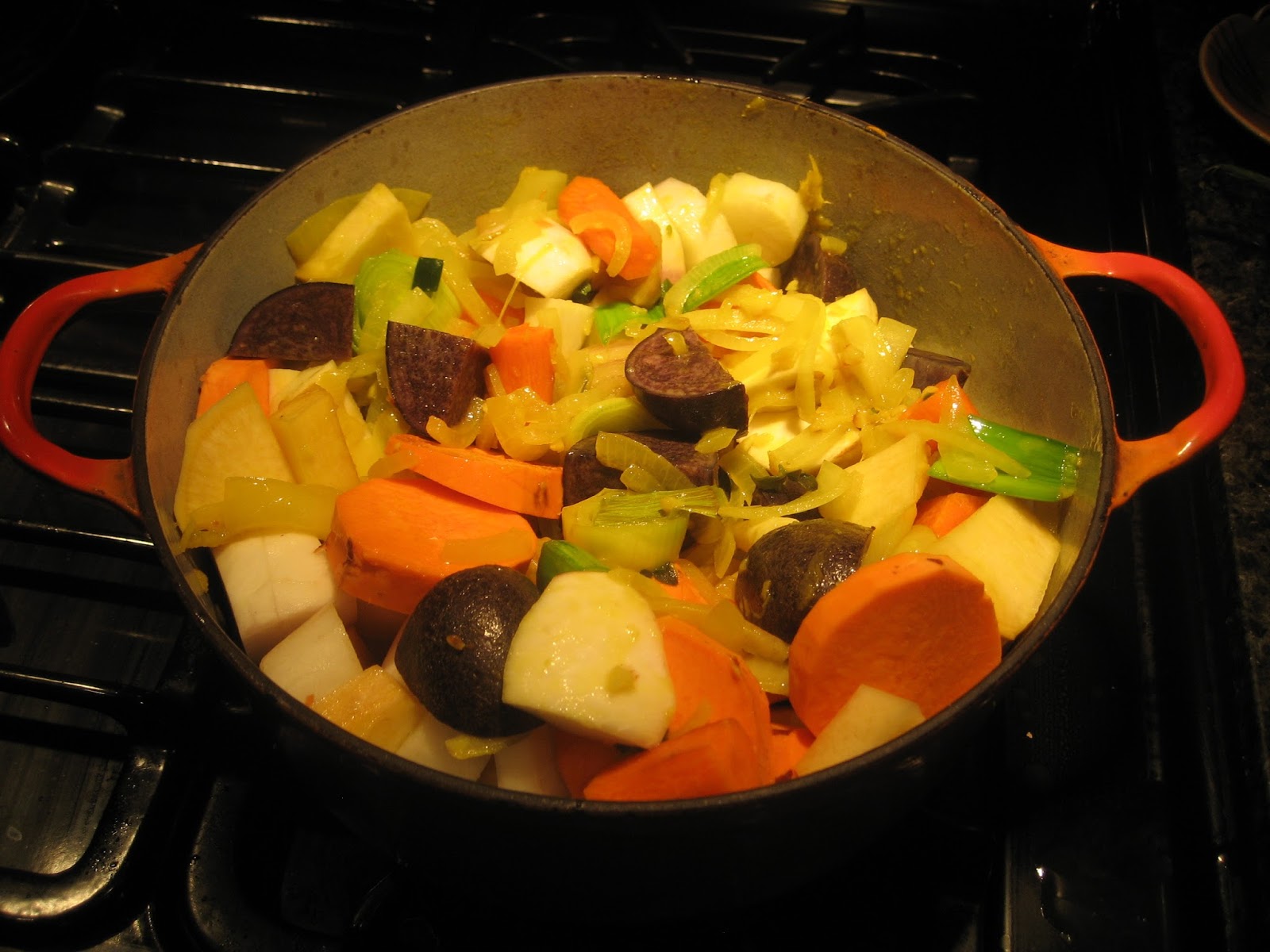
Serves 6-8
1 lg onion, peeled 
1 small rutabaga, peeled and coarsely chopped into bite-sized pieces 
1 white turnip, peeled and chopped into bite-sized pieces 
3 carrots, peeled and cut crosswise into 1” pieces 
1 parsnip, peeled and cut into ½” disks 
1 sweet potato, peeled and sliced into thin disks 
1 leek, washed and cut into ½” disks 
1 sm daikon, peeled and cut into thin disks 
1 small celeriac bulb, peeled and coarsely chopped 
6 purple or red round potatoes, washed and quartered 
1 shallot, peeled and thinly sliced 
2” piece of fresh ginger, peeled and minced 
4 lg garlic cloves, peeled and minced 
½ tsp ground turmeric (this is a rhizome) 
3 tbsp olive or peanut (a ground nut) oil
1 tsp salt 
¼ tsp ground chipotle powder or smoked paprika  
2 tsp dried marjoram leaves  
1 tsp ground coriander (this is the root of the plant) 
1/8 tsp ground black pepper 
1 ½ c vegetable broth or water 
½ c chopped tomatoes 
½ c fresh parsley sprigs, chopped 
1 c dried polenta meal 
½ c buttermilk 
1 tsp salt  
2 tbsp plus 1 tsp butter
¼ cup grated parmesan, romano or asiago cheese
4 cups water 
pinch of nutmeg
 
Slice the onion into thin disks, slice each disk in half and then in half again. Heat the oil in a large casserole or small soup pot over medium heat. Add the garlic, ginger, black pepper and turmeric and stir-fry for 30 seconds. Add the shallot slices, onion and leek. Sauté for 3-5 minutes until soft. They will be colored by the turmeric. Stir in ground coriander, chipotle or smoked paprika and marjoram. Put remaining root vegetables in the pot. Add salt and broth or water. Raise heat to a boil. Cover, lower heat to simmer and cook 20 minutes.

Preheat an oven to 350º. Get a large ovenproof casserole or deep-dish pie pan.
In a large saucepan, boil the 4 cups of water and salt. Stir in polenta and 2 tbsp of butter and stir rapidly to blend, so the polenta doesn’t lump up. Continue stirring and cooking the polenta for 4-5 minutes, until it starts to release large bubbles. Remove from heat and stir in buttermilk. Stir tomatoes and chopped parsley into the vegetables.

Fill the casserole or pie dish with the vegetables and their juice, leaving about ¼” at the top. Using a large kitchen spoon, spoon the polenta over the top to create a crust, up to ½” thick is okay. Be sure to cover the edges and smooth the top.  Cut the tsp of butter into tiny pieces and scatter on top of the cooked polenta. Sprinkle on the cheese and the pinch of nutmeg.

Put the potpie in the center of the oven and put a large cookie sheet on the rack below it to catch any spills. Cook for 20-30 minutes, until the top vaguely starts to brown and crisp. Remove and let it cool for 5-10 minutes before serving.

I'll serve up more root vegetable ideas later on as winter markets have nothing but them.

Sunday, October 16, 2016

Making the homely celeriac bulb feel at home

It's easy to pass by the hairy, homely celeriac bulb, also known as celery root. It's probably the ugliest offering in the farmers' market.
Yet once you get beyond that leathery skin and those roots hairs, you get pure celery sweetness with a hint of fresh parsley. Plus you get hard to find potassium, Vitamin K, and Vitamin B6 along with lots of Vitamin C and crucial dietary fiber. And you get it all with absolutely no fat. This is a prize for getting to October. So be a winner and get some.
Here are a few tasty ways to treat it-- once you've peeled it, of course. Not saying that's easy...

Basic Mashed Celeriac
This is how I discovered the bulb: my French family always made mashed celeriac for their huge Christmas eve feast and served it with venison. It perfectly cut the rich gamey meat flavor with the look and feel of mashed potatoes but none of the calories or cholesterol. It was so memorable I took to carrying celeriac bulbs from fancy Manhattan markets every fall to mash them for Thanksgiving. They are perfect with roast turkey.
for 4-6 servings

1 lg celeriac bulb, peeled clean and washed
3-4 cups chicken broth, vegetable broth or water
1 tsp celery seed or flakes
pinch of salt
2 tbsp creme fraiche or sour cream

Do your best to chop the bulb into maximum 2" chunks. Put in a large saucepan and just barely cover with the broth/water.  Add the celery seed/flakes and salt. Bring to a boil, cover, lower heat and cook on low 30 minutes or until the chunks are very soft. Check from time to time that there is always liquid in the pot. To purée: if you have an immersion blender, drain off all but 1/4 c of the cooking liquid and whir to mash. Add the creme fraiche/sour cream and blend to a smooth consistency. Use a little more cooking liquid if you need it to do that. Season with salt and freshly ground black pepper to your taste and serve hot.
P.S. You can add celeriac mashed to mashed potatoes or cauliflower.

Celery Remoulade
This is another classic, common French dish: basically celeriac slaw.  

1 cup mayonnaise 
1 tbsp Dijon mustard 
1 tsp sea salt, plus more, to taste 
3 tbsp freshly-squeezed lemon juice 
freshly-ground black pepper 
1 lg (approx 2 lb) celery root
(the photo shows grated celeriac before dressing) 
Make the dressing first because celery root can discolor when it hits air. Mix together the mayonnaise, mustard, 1 tsp salt, lemon juice, and a few grinds of black pepper. Peel the celery root --you made need a good chef's knife,and grate it coarsely into match stick sized pieces. Mix the dressing with the celery root and taste, adding additional salt, pepper, mustard, and lemon juice, to adjust. Garnish with minced flat leaf parsley or chives. You can serve this to great effect with charcuterie, sausages or burgers.
Baked celeriac served with capers and smoked trout

This is from London, from famed chef Yotam Ottolenghi, for a first course or brunch with scrambled eggs.

1 medium celeriac, skin scrubbed but unpeeled, cut in half lengthwise
2 tbsp olive oil
4-5 thyme sprigs
Flaky sea salt and black pepper
1/3 c creme fraiche
1 1/2 tbsp fresh horseradish, peeled and finely grated (or prepared jarred horseradish)
2/3 lb sliced smoked trout or salmon, each slice cut into 1” wide strips
2 tsp lemon juice, to serve
For the salsa
1½ tbsp small capers (or normal capers, chopped)
1 tbsp parsley leaves, minced
2 tsp tarragon leaves, finely chopped  
1½ tbsp olive oil
Heat the oven to 350º. Put each celeriac half on a separate piece of foil large enough to wrap it in. Dribble a tablespoon of oil over each celeriac half, scatter the thyme and three-quarters of a teaspoon of salt on each half, and rub all over. Add a generous grind of pepper, then tightly wrap the celeriac halves in the foil. Bake for an hour, until soft, then unwrap and set aside for half an hour, until they come to room temperature.
Meanwhile, mix the creme fraiche and horseradish with a pinch of salt and a grind of pepper, then refrigerate. Mix the salsa ingredients in another bowl.
To serve, cut each celeriac half into four even wedges. Put two wedges on each serving plate and spoon over them some horseradish cream. Lay some fish strips on top and drizzle with salsa. Squeeze half a teaspoon of lemon juice over each portion and serve immediately.
Hearty Gratin of Potatoes, Celeriac and Ham

Serves 6-8

1 tbsp olive oil (you can use butter if you prefer)
1 small onion, diced
2 garlic cloves, peeled and minced
2 cups heavy cream (you can substitute one cup of evaporated milk for one cup of cream but the final dish will be soupy)
½ tsp salt
½ tsp coarsely ground black pepper
¼ tsp ground nutmeg
1/4 tsp dried rosemary
¼ tsp dried sage
pinch of ground cloves
1 ¼ lb baking potatoes, peeled and sliced into thin disks
1 medium celeriac (1lb), peeled and sliced into thin disks
1 large leek, sliced into thin disks and washed
1/2 lb baked ham, sliced thin
½ lb. Gruyere cheese, grated

Preheat oven to 375º and get out a baking pan approximately 11” x 7”. 
Heat the olive oil in a small sauté pan.  Add garlic and onion and sauté over medium heat about 3 minutes, until the onion starts to soften.  Remove from heat and add the salt, pepper and nutmeg.  Stir in the cream.

Spread the leeks evenly around the bottom of the baking dish. Don’t worry if there are gaps, just be sure they are uniformly around.  Cover the leeks with a layer of potatoes (half the potatoes). Sprinkle the rosemary over the potatoes, then sprinkle ½ cup of cheese. Add a layer of celeriac, using half of what you have and top it with a layer of ham slices. Sprinkle the sage and cloves around this layer,  then ½ cup cheese. Repeat a layer of potatoes and cheese, then a layer of ham and top with last layer of celeriac.

Pour the creamy onion mixture over everything as evenly as you can and bake for 30 minutes in convection or 35 minutes in a regular oven.  Sprinkle the remaining cheese over the top and continue to bake another 12-15 minutes, or until the celeriac is tender and the cream seems to be solid. (It won’t be if you used evaporated milk.)  Remove from the oven and let it cool at least 5 minutes before serving.  You can sparingly add freshly chopped flat leaf parsley for color if you wish.

Seafood chowder with celeriac
serves 3

1 lg celeriac (about 1 1/2 lbs)
1/2 fresh lemon
1/2 lb pancetta
1 shallot
1 tbsp dried thyme leaves
2 lbs haddock
3 1/2 c  fish stock or vegetable broth
2-2 1/2 lbs clams
fresh flat leaf parsley for garnish

Peel the celeriac and get rid of all those root fibers. Coarsely grate it into match stick pieces and put in a bowl with lemon juice to prevent discoloring.  Peel, halve and roughly chop the onion. Cube the pancetta, removing any tough skin. Put it in a heavy bottom deep soup pot, turn the heat to medium and sweat the fat out of it to lube the pan. Add a tbsp of oil if you need to stop sticking.  Once the pancetta starts to turn golden, add grated celeriac and stir. Add the onion and thyme, stirring to blend. Cook until everything is soft, golden and aromatic--8-10 minutes. Trim the haddock into very large chunks and remove any skin. Push the onion mix to one side and gently lower the haddock pieces onto the other to lightly brown them. Turn carefully with a good spatula to brown the other side. Then pour in the stock/broth. Bring to a boil and immediately lower heat to simmer so the soup bubble gently. Simmer 5 minutes.Meanwhile scrub and inspect the clams, discarding any that don't shut. Add to the soup and cover the pot tightly with a lid. Check after 3 minutes. If the clams have opened, taste and adjust salt and pepper, then lade the soup into serving bowls. Garnish with minced parsley leaves.

Celeriac with buckwheat (kasha) and ham
serves 4

1 lg celeriac bulb, peeled and cubed
2 tbsp olive oil
4 sprigs of thyme or 1 tsp dried leaves
2 tbsp buckwheat groats (aka kasha)
1 1/2 tbsp butter
1 sm onion, peeled and sliced
2 garlic cloves, peeled and sliced very thin
1 c chicken stock or vegetable broth
4 thin slices of air-dried ham or proscuitto, torn into pieces
Salt and freshly ground black pepper

Preheat oven to 400º. Scatter half the cut celeriac over a roasting tray or baking sheet. Sprinkle over it 1 tbsp olive oil, salt and pepper. Sprinkle on the thyme and put the tray in the oven for 15-20 minutes, until celeriac is tender and starting to caramelize around the edges.

Meanwhile, toast the buckwheat by scattering it around a small baking sheet or pan and putting it in the same oven for 6-8 minutes. Remove promptly and cool.
Put a medium saucepan over low heat. Add half the butter and the remaining olive oil. When it's bubbling hot, add the onion and garlic. Cook gently for 5-6 minutes until soft and starting to brown at the edges.
Add the remaining celeriac to this pot. Season with salt and pepper. Pour over the stock, cover the pot and simmer on low heat 15-20 minutes, until the celeriac is tender. Add the remaining butter.
Using an immersion blender purée the contents of the pot to a smooth consistency. If you don't have one pour the contents into a blender or food processor and do the same. Taste for salt and adjust.

Spread the warm puree over a serving platter. Scatter the roasted celeriac chunks on top, sprinkle with the roasted buckwheat and top with the torn ham. 


Sunday, October 9, 2016

Garbage mouth, aka food rehab

So many people have become aware of how much food is wasted when so many are hungry, there's now an international organization dedicated to turning farm trash into farm fresh meals. It's called Feedback, it's out of London and it's staged mass feedings in 41 major cities around the planet to raise more awareness. Yesterday, Friday October 7 it was in the smallest city yet to serve up trash, Portland, Maine, where soup for 5000 people came from 4000 lbs--that's two tons, of veggies that local farms would've plowed under because they weren't pretty or they were just too abundant.

All the talk served with the soup was about how many people, especially children, are hungry because they can't afford or reach food when there is plenty of it out there. It was equally about utilizing not only every part of every edible animal, but every veggie and fruit that comes to life to spread the wealth and health. Carrots with a gnarl have the same vitamins and taste as beauty pageant ones. Ditto bell peppers with a dent or cabbage heads with a black spot on the outer leaves.

Sadly, nobody pointed out the more obvious: the bigger waste problem and easier one to tackle is in the kitchen. Frankly, I could've run that garbage to goodness gamut all by myself with volunteers gleaning in my kitchen. I pig out at farmers' markets: all those mile high piles of gorgeous, colorful produce make me hungry to have it all and I can't help myself so I overdose.  Eyes way wider than stove top and stomach. And of course after a few days, I've got stuff starting to rot all over my fridge and counters.

I know I am not the only pig out there who regularly overdoses and needs food rehab. I have friends who won't even eat their own leftovers. So let's talk yet again about how to deal with all that edible stuff stuck in your life uneaten and unloved. Let's not go on a long guilt trip about tossing it when people are starving....not in Darfur but right in your own bailiwick these days. In Maine, where the event took place, more than 1/4 of schoolchildren go hungry.

As I said, they could've run the event out of my kitchen. In the last week alone, from the lonely in the fridge, freezer and breadbox, I've made two incredible pots of soup, garlic croutons, roasted spiced pumpkin (squash) seeds and mixed pesto--much of which I gifted others. The essential ingredients for all those recipes were will and a few minutes. It's awareness practice. And it makes me feel good. So I am sharing.

I've already posted lots of recipes for stomachfill instead of landfill. But in the spirit of Feedback, here are some of the big winners again along with a new one or two. For a whole host of how to make leftover bread into fabulous breadcrumb dishes, check out the post of March 2015. You'll be rewarded with the greatest chocolate bread pudding recipe ever baked.

Chili spiced roasted pepitas (pumpkin/squash seeds)
Easy to make, tasty to munch and outrageously nutritious to boot, so don't throw away those seeds.
Yes, it's a pain to scrape and clean them but you'll forget that once you dig in to the finished product.
(Or cheat by buying a bag.)

3-4 cups clean, dry pumpkin/squash seeds
2-3 tbsp corn or canola oil
2 tsp (or more if you like salty) salt
3 tsp chipotle or ancho chili powder
1/4 tsp ground cinnamon
1/4 tsp ground ginger
1 tsp ground cumin
1/4 tsp ground coriander
OR: just use your favorite spice combo and include chili powder or hot paprika

Preheat the oven to 325º. Put the seeds in a large bowl and add the oil, stirring to blend so all the seeds get coated. Add the salt and all spices and blend everything really well.  Pour the seeds onto a cookie sheet and spread into the thinnest possible layer. (I line my sheet with cooking parchment to spare cleanup.  Roast for 20-30 minutes until the seeds are dry, brown and crunchy. Cool and dig in. These store in tightly closed tins and jars. I keep my jar in the fridge and sprinkle them on lettuce salads all winter.

Trash Torte
This is for all those annoying carrot, radish, beet, leek and turnip tops, fennel fronds, and those stray leaves of arugula, chard, lettuce and kale you didn't use. Decorated in the photo with spring garlic scapes. It's gluten free, vegan, thrifty and incredibly nutritious.


Chop whatever you've got up in a large bowl. You'll need about 3 big handfuls. If you've got scallions around dice them in. Add whatever herbs you can scavenger: dill, cilantro, mint, flat leaf parsley in any combination. Season with sea salt and pepper. Add a pinch of red pepper flakes, crumble in 3 oz goat or feta cheese, and bind it all together with an egg or two (depending on how many greens you have). Spread the mix out in a shallow oiled baking/quiche dish large or small enough so that the "pie" is no thicker than 1/2". Top with a sprinkle of nutmeg and bake at 350º until it is firm enough to spring back to the touch (maybe 15 minutes). Slice in wedges and enjoy warm or at room temperature.
Ribollita
This is how Italians, who do know how to cook tasty, turn their leftover bread into scrumptious, hearty soup, It will use up the fall veggies languishing in your fridge right now and best of all that Parmesan rind you were going to toss out. You have no idea what tantalizing flavor it brings to soup til you toss it in.
For 4-6

3 tbsp and 2 tsp olive oil
1 med onion, peeled and diced
1 lg garlic clove, peeled and minced
½ tsp dried rosemary leaves
2 sm or 1 lg celery stalks, finely chopped
1 lg carrot, peeled and finely chopped
½ Savoy cabbage, shredded
4 stalks red chard, stems removed and chopped
1 bunch Tuscan/lacinto/blue kale, stems removed and chopped
6-7 cups broth or water
salt and freshly ground black pepper to your taste
2 cans (14 oz) cannellini (white kidney) beans, drained
1-2 tbsp tomato paste 

6 slices day or two old (i.e.stale) Tuscan or other dense crusty Italian bread
Fruity olive oil for final garnish
Optional: that Parmesan rind you were going to throw out


Coat bottom of a large heavy-gauge pot with 3 tbsp olive oil and heat on medium flame. Add onion, garlic, rosemary, celery and carrots. Sauté until soft, 5 minutes. Season with freshly ground black pepper to your taste.  Add Savoy cabbage and chard, stirring to blend, and cook until they wilt.

Add broth, cheese ring, salt and kale. Bring to boil, reduce heat to simmer, cover pot and simmer 40-45 minutes, until vegetables are soft. Timing does not have to be precise.
Purée 1 can of beans. Add puréed and whole beans to the soup along with the tomato paste. (suit yourself with how much) Stir to blend everything. Continue to simmer with lid on pot 15 minutes. Stir from time to time so nothing sticks to the bottom. Taste for salt and correct if necessary.

At this point, you can be very Tuscan and get out a large earthenware casserole pot, then layer the bread and soup in it. Or you can simply add the bread to the soup pot you’re already using, trying to “layer” it in. In either case, remove soup from heat and let cool. Refrigerate overnight so it sets up.
To serve: stir in 2 tsp olive oil. Reheat on low flame or in the oven until hot enough to eat. Garnish with fruity olive oil.


Garlic Croutons/Crackers
If making soup is just too much, here's how you can quickly and effortlessly turn your leftover baguettes and rolls into yummy soup and salad croutons or bruschetta like crackers.


 Slice your not so fresh baguette into 1/4" pieces.
In a shallow bowl, combine a lg garlic clove minced with a pinch of salt and 1/4 c olive oil.  Dip the bread slices into the flavored oil, then lay them in a single layer on a baking sheet. To save clean up line the sheet with tin foil or parchment. Bake at 300º until they are dried out, golden and crunchy--30-45 minutes. If you don't have that many, you can do this in a toaster oven too.

These last a long time in a tightly lidded tin. You can pull them out for onion or puréed soups, Caesar or panzanella salad (recipe in earlier post), or use them like bruschetta. The other night I spread on herbed goat cheese and topped it with garlic roasted tomatoes. I've also done it with fire roasted peppers from a jar.

We'll continue this discussion later.
Up next, make celeriac feel at home.


Monday, October 3, 2016

More for the Moment: Enter October

As frost comes closer and farms slowly transition to featuring mostly root veggies, here are a few transitional dishes for entering October. (Apologies for this post without pictures. I stuffed it with recipes instead.) How to make celeriac feel at home and how to get back to your roots will come soon.

English Chicken with Leeks and Apples (from Diana Henry)
serves 4

8 chicken thighs with skin and bone
salt and pepper to your taste
3 tbsp unsalted butter
1 1/2 lb leeks
2 Granny Smith or honey crisp apples
1 tbsp flour
2 c cider
8 sprigs of fresh thyme
3/4 c heavy cream
1 tsp sugar


Season the chicken pieces and heat 2 tbsp butter in a large lidded sauté pan or wide casserole on med/low heat. Brown the chicken on both sides and then set the pieces aside while you cook the leeks. (Make sure not to burn the butter.)
Remove the tough outer leaves from the leeks. Trim the bases and cut off the tough, very dark leaves at the top. Wash the leeks really well, making sure that you get rid of any soil that is lodged in them. Cut into about 1" lengths. Add the leeks to the buttery pan and sauté without browning for about 10 minutes; they should soften but not become sloppy.
Meanwhile, peel one of the apples, halve and cut into wedges. Melt the remaining butter in a small frying pan and gently brown the wedges on each side. Leave until you need them.
Add the flour to the leeks and turn them over in the juices. Continue to cook for a couple of minutes. Take the pan off the heat and slowly add the cider, stirring all the time. Return to the heat, bring to the boil, then add the chicken, sprigs of thyme and the sauteed apple (don’t wash the apple pan).
Immediately reduce the heat to a simmer, put the lid on and leave to cook over a low heat for about 35 minutes. The chicken should be cooked through, with no trace of pink.
Lift the chicken pieces out of the casserole and simmer the cooking juices until reduced by about one-third. Add the cream, bring to the boil and cook for a couple of minutes.
Peel and cut the other apple into wedges and put in the frying pan in which you cooked the first apple. Sauté gently, adding the sugar to help the slices caramelize on the outside.
Cook until the apple slices are tender. Return the chicken to the sauce and heat gently. At the last minute, add the newly sautéed apples, sprinkle with the thyme leaves and serve.

Onion Puree
serves 4
1 1/2 lbs (2 very large) sweet onions
3/4 c water
1 tbsp canola or peanut oil
pinch of salt
1/2 tsp dried thyme
1/4 tsp cracked black pepper
1 bay leaf
1/4 tsp celery seed
3 tbsp fine cornmeal
2 tbsp heavy cream or low fat Greek yogurt

Peel the onions and slice very thin. Put them in a large stainless steel or enamel (not aluminum) saucepan with all the ingredients except cornmeal and heavy cream/yogurt. Bring to a boil. Cover, reduce heat to low and cook 35 minutes.

Remove the bay leaf. Sprinkle the cornmeal on top, then stir it in. Cook covered another 15 minutes, stirring occasionally. Run a whisk through to break up the onions a bit. Stir in the cream/yogurt and cook just until the dish is hot. Do not boil. Check for salt and pepper and adjust if necessary. Serve immediately. Possible garnishes to toss on top: chopped chives, chopped flat leaf parsley, chopped cilantro.  This is excellent with any roasted or grilled meat.

Fried Green Tomato Sandwiches
from How to Fix a Leek....the book


5 med green tomatoes
1½ c matzo meal or fine breadcrumbs 
¼ c all purpose flour
4 oz fresh goat or ricotta cheese 
1/2 c cornmeal 
1 tbsp minced parsley with chives 
1 egg 
3 slices crisp cooked bacon, crumbled* 
½ c milk 
 Peanut or corn oil for frying 
*Vegetarians: use chopped olives

In a small shallow bowl whisk together flour and cornmeal. Whisk in egg, milk and salt to your taste. Slice tomatoes into 1/8” rounds, keeping them together. Take 2 abutting slices side by side and open them like a book. Season with salt and freshly ground pepper, smear goat cheese on the inside of one all the way to the edges and top it with herbs and bacon. Cover with the other tomato slice, salt and press lightly. Dip in the cornmeal batter to coat and roll in the breadcrumbs.The two sides should stick together now.

    Fill a frying pan or skillet almost 1” deep with oil and heat it to sizzling (it will spit if you flick a drop of water on it). Fry the tomato sandwiches 2 minutes and turn over to fry another 2 minutes or until golden brown. Drain on paper towels and keep warm to serve. Sprinkle with freshly ground pepper and serve with salsa or chopped olive mix.


Green Tomato and Onion Curry
 serves 4 an exotic taste of India

2 tbsp vegetable oil
1 heaped tsp small black mustard seeds
1 heaped tsp cumin seeds
4-5 curry leaves*
1 medium onion
1 clove garlic
1 lb green tomatoes firm and healthy looking
1 1/2  tsp salt
1/4 tsp turmeric powder
1 1/2 tsp ground cumin
1/2 tsp ground coriander
1-2 tsp red chili powder – more as you wish
Optional: 1/2 tsp amchur (dried mango powder)
Handful fresh cilantro leaves, chopped
*These are available in spice jars at Indian and Asian groceries and international themed supermarkets. They have no real substitute as they impart both a tangy citrus and slightly sweet anise like flavor. they are edible and do not have to be removed like bay leaves. Better yet they can be frozen for the long haul so it's not a waste to buy a jar. Here's a chance to go exotic on the cheap!

Slice the onion and garlic. Chop the tomatoes into large chunks about 1 inch.  Smaller will turn them to mush.

Heat the oil in a wok or other pan used for stir fry. Nothing heavy.
When the oil is hot add the mustard seeds, cumin seeds and curry leaves in quick succession.  To test the oil you can pop in a mustard seed. If it fizzles and pops then it’s ready.  Stir for a minute with a fork --not wooden spoon. Add the onions and stir fry a minute.
Add the tomatoes, then the rest of the spices. Stir until all the spices are well combined.
Keep tossing the onions and tomatoes with the fork for a few more minutes to cook the dry spices out and prevent sticking.  If it does stick add a little more oil or water.
Do not overcook.  You want the tomatoes to keep their shape.
Pour into a serving bowl, top with the chopped coriander and serve immediately.  This dish does not keep well. It is, as I said, just for the moment.

Sautéed greens with olives
Greens are in abundance now and as sunshine wanes, we need all their chlorophyll we can get because that seems to be a magic bullet cure-all.
serves 6

2 tbsp olive oil
4 garlic cloves, thinly sliced
1/4 tsp crushed red pepper flakes
10 cups mixed greens torn into pieces (about 3 bunches kale, chard, turnip greens, mustard greens, beet greens, endive, romaine lettuce, arugula)
1/3 c pitted black olives, halved
2 tbsp fresh lemon juice
Sea salt and freshly ground black pepper to your taste

In a large skillet, heat oil on medium heat. Add garlic and sauté stirring 2 minutes until it begins to brown. Add pepper flakes, stir and saute until fragrant, about 1 minute. Add greens a handful at a time, each time seasoning what you've added with salt and pepper. Cook stirring until the greens are all wilted and soft, about 3 minutes. Add the olives and lemon juice and toss to blend. Shake in a few more red pepper flakes. Taste for seasoning and add a few more drops of lemon if you need to.  An excellent side dish for fish, roasted meat or chicken, or a vegetarian meal with corn pudding and panzanella salad. (see much earlier post)

Corn Cakes with Indian Spices and Yogurt
serves 4


3 ears of corn or 1¼ lb frozen kernels
¾ c chickpea flour or fine cornmeal
½ tsp baking powder
1 tsp garam masala or curry powder
½ tsp ground cumin
pinch of cinnamon
1 tsp turmeric
½ tsp paprika

3 large eggs, separated
1/2 c milk
2 spring onions, chopped
½-1 red chili, finely chopped, according to taste
2 limes, zest and juice
1 big handful chopped cilantro leaves
Salt and freshly ground black pepper
1 ½ tbsp butter
1-2 tbsp olive oil

For the yogurt 

1/2 c Greek yogurt
1 tsp cumin or nigella seeds
1 lime, zest and juice
1 tsp grated fresh ginger

Heat the oven to 275º. Have a cookie sheet ready.

Hold the corn upright and, using a sharp knife, carefully cut the kernels into a large, wide bowl that catches all the flying ones. Sift the flour and baking powder into a smaller bowl, add the spices and make a well in the center. Put the egg yolks and half the milk in the well, beat the mixture until smooth, then slowly whisk in the rest of the milk. Fold in the corn, onions, chili, lime juice and zest, and cilantro leaves. Whisk the egg whites to soft peaks and gently fold them into the batter. Season with salt and pepper to your taste.
Heat a heavy-bottom frying pan on a medium high heat and once it’s hot, add a small knob of butter and a dribble of oil. Drop two heaped tablespoons of batter into the pan to form one cake and fry on medium heat for 3 minutes a side, until golden brown and cooked through. Transfer to a tray in the oven while you repeat with the rest of the batter.
Once all the corn cakes are in the oven staying warm, mix all the yogurt ingredients, then season with salt. Serve the fritters with the yogurt on the side or dribbled over the top garnished with chopped cilantro leaves.
Radishes with miso
(bet you never thought to cook radishes!)

serves 4 a Japanese touch to the table
2 tbsp unsalted butter (1/4 stick), at room temperature
2 tbsp red miso paste, at room temperature
3 bunches medium radishes with their tops
2 tbsp vegetable oil
Kosher salt
2 tbsp water
1/4 tsp rice vinegar

Place the butter and miso in a small bowl and mash with the back of a spoon until evenly combined; set aside.Cut the leafy tops from the radishes. Coarsely chop, wash, and dry the tops; set them aside.
Wash the radishes, trim the stem ends, and halve them (quarter them if they’re large) and set aside.
Heat the oil in a large frying pan over medium-high heat until shimmering. Add the radishes and arrange them cut-side down in a single layer. Season with salt and sear until golden brown, about 4 to 5 minutes. Flip and cook the other side until golden brown and the radishes are crisp-tender, about 3 to 5 minutes more.
Reduce the heat to medium. Add the radish tops, 1 tablespoon of the water, and salt to taste. Cook, tossing occasionally with tongs, until the tops are completely wilted, about 2 minutes. Remove the pan from the heat. Add the butter-miso mixture and the remaining tablespoon of water and stir until the butter-miso mixture melts and coats the radishes and tops. Add the vinegar and stir to combine. Taste and season with salt as needed.

Chinese style mustard greens and mushrooms
a tribute to autumn mushrooms with the flavor of China

1/4 cup good quality olive oil
2 king oyster mushrooms or 6 oz white button mushrooms
6 med shiitake mushrooms
4 med shallots, quartered lengthwise
2 garlic cloves, thinly sliced
1 star anise (whole)
1 tsp Chinese five spice powder
1/2 c dry rice wine or dry white wine
1 bunch mustard greens, stems off (about 10 oz)
1 c mushroom broth
Salt and pepper to your taste

In a large saucepan, heat oil. Add oyster or button mushrooms, shallots and a generous pinch of salt. Cook over med/high heat about 3 minutes until they just start to soften. Add the shiitakes, garlic, star anise and five-spice powder. Add the wine and simmer about 2 minutes until it has evaporated. Add the mushroom broth and bring the pot to a boil. Immediately lower heat to med/low and simmer until the liquid has started to reduce/disappear, about 10 minutes. Add the mustard greens and cook, stirring occasionally until they wilt and look tender, about 5 minutes. Remove the star anise. Season with salt and pepper and serve.